
Contents
Overview
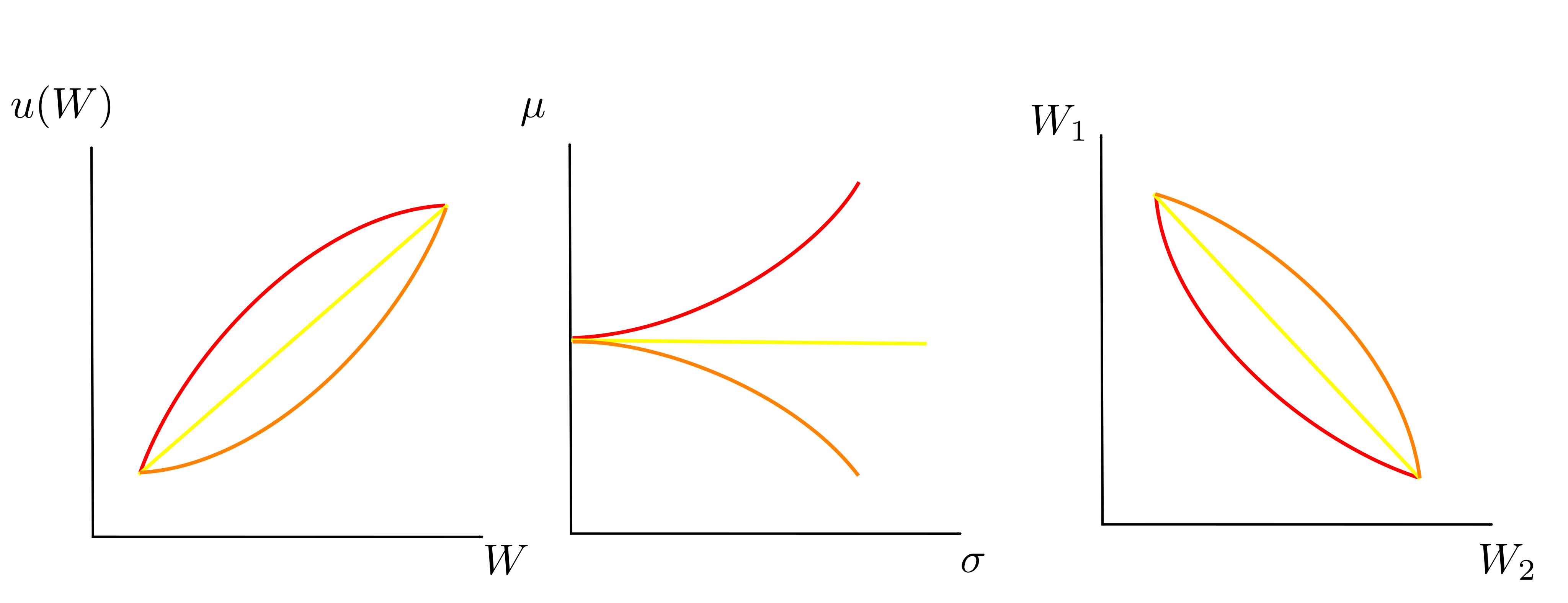
Understanding risk tolerance is essential for investors to make informed decisions about their investments. Risk tolerance refers to an individual's ability to withstand potential losses in their investments, and it is a critical component of investment planning. Investors with a high risk tolerance can withstand greater market fluctuations and are more likely to invest in assets with higher potential returns, such as stocks. On the other hand, investors with a low risk tolerance may prefer more conservative investments, such as bonds or money market funds. The concept of risk tolerance is closely related to risk aversion, which is the tendency of people to prefer outcomes with low uncertainty to those outcomes with high uncertainty. By understanding their risk tolerance, investors can create a diversified portfolio that aligns with their financial goals and risk profile.
🎵 Origins & History
Origins paragraph — The concept of risk tolerance has its roots in the field of economics and finance, where it is closely related to the concept of risk aversion. For example, a study by Fidelity Investments found that investors who are more risk-tolerant are more likely to invest in exchange-traded funds (ETFs) and index funds.
⚙️ How It Works
How it works — Risk tolerance is a complex concept that involves both psychological and financial factors. It is influenced by an individual's personality, financial goals, and investment experience. Investors with a high risk tolerance are more likely to invest in assets with higher potential returns, such as stocks and real estate. On the other hand, investors with a low risk tolerance may prefer more conservative investments, such as bonds and money market funds. For instance, Robinhood and eToro are popular platforms for investors with a high risk tolerance, while Vanguard and Charles Schwab are popular among investors with a low risk tolerance.
📊 Key Facts & Numbers
Key facts — Investors with a high risk tolerance are more likely to invest in assets with higher potential returns. According to some sources, the use of risk assessment tools can help investors determine their risk profile and create a diversified portfolio.
👥 Key People & Organizations
Key people — Experts in the field of finance have written extensively on the topic of risk tolerance. Other notable investors have also shared their insights on risk tolerance and investment strategies. For instance, Ray Dalio and Carl Icahn are well-known investors who have shared their insights on risk tolerance and investment strategies.
🌍 Cultural Impact & Influence
Cultural impact — The concept of risk tolerance has had a significant impact on the investment industry, with many financial institutions and investment platforms offering risk assessment tools and services to help investors understand their risk tolerance. For example, Fidelity Investments offers a risk tolerance assessment tool that helps investors determine their risk profile and create a diversified portfolio.
⚡ Current State & Latest Developments
Current state — The current state of risk tolerance is closely tied to the overall market conditions and economic trends. With the increasing volatility in the markets, investors are becoming more risk-averse, and there is a growing demand for more conservative investment products. For instance, Goldman Sachs and Morgan Stanley are leading providers of market research and analysis, helping investors navigate the complex investment landscape.
🤔 Controversies & Debates
Controversies — One of the controversies surrounding risk tolerance is the debate over whether it is a stable trait or if it can change over time. Some researchers argue that risk tolerance is a stable personality trait, while others argue that it can be influenced by external factors such as market conditions and investment experience. For example, a study found that investors who are more risk-tolerant are more likely to take on more debt, which can increase their overall risk exposure.
🔮 Future Outlook & Predictions
Future outlook — The future outlook for risk tolerance is closely tied to the development of new investment products and technologies. With the increasing use of artificial intelligence and machine learning in investment decision-making, there is a growing need for more sophisticated risk assessment tools and services. For instance, robo-advisors like Betterment and Wealthfront are popular among investors who want to automate their investment decisions and minimize their risk exposure.
💡 Practical Applications
Practical applications — Understanding risk tolerance has many practical applications in investment planning. Investors can use risk assessment tools and services to determine their risk profile and create a diversified portfolio that aligns with their financial goals and risk tolerance. For example, Vanguard and Fidelity Investments offer a range of investment products and services that cater to different risk profiles.
Key Facts
- Year
- 2022
- Origin
- United States
- Category
- investing-101
- Type
- concept